
The Necessity of Water Softening in Steam Boiler and Steam Generator Systems
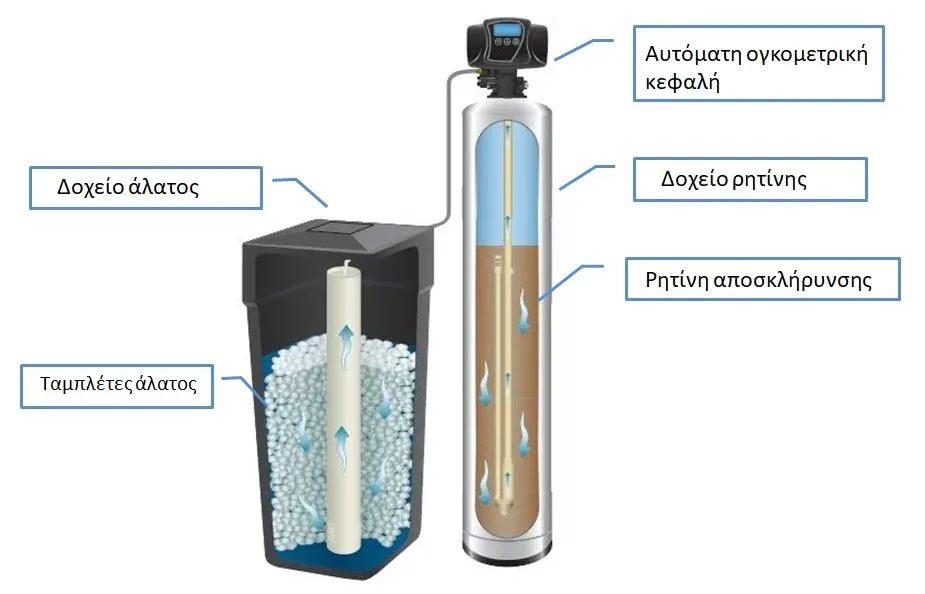
The quality of feed water is one of the most critical factors for the efficient, safe, and long-term operation of any steam boiler or steam generator. Hard water—meaning water that contains high concentrations of calcium (Ca²⁺) and magnesium (Mg²⁺) salts—causes serious problems such as scale formation, corrosion, and loss of thermal efficiency.
To prevent these issues, the process of water softening is applied, which has now become a requirement under European legislation (according to the PED 2014/68/EU Directive) for all boiler rooms and steam production systems.
⚙️ How Water Softening Works
Water softeners use ion exchange resin (cation exchange resin) to remove calcium and magnesium ions. As water passes through the resin tank, Ca²⁺ and Mg²⁺ ions are exchanged with sodium (Na⁺) ions contained in the resin.
As a result, the outgoing water is free from the elements that cause hardness.
However, after a certain period of operation, the resin becomes saturated and is no longer able to retain additional ions. At that point, resin regeneration is required.
🔄 The Regeneration Process
Regeneration is carried out using a salt solution (NaCl), commonly known as brine.
During this process:
- The brine solution passes through the resin column.
- Sodium ions replace the calcium and magnesium ions that had been captured.
- The discharged impurities are removed through flushing, and the resin returns to its original condition, ready for operation again.
This process can be performed automatically via an electronic control panel and programmed regeneration, either based on time or on the volume of treated water.
🔁 Single and Twin-Head Water Softeners
There are two main system types:
- Single-head softeners, where the resin is taken out of service during regeneration. These are suitable for installations with intermittent operation.
- Twin-head softeners, where two resin tanks operate alternately. When one is in regeneration, the other remains in operation, ensuring a continuous supply of softened water. This solution is ideal for industrial installations and steam boilers with 24-hour operation.
🧪 Legislation and Compliance
Water softening is not an optional process. According to European pressure equipment standards (PED 2014/68/EU) and national safety regulations, every steam boiler or steam generator installation must be equipped with a water treatment system that includes a softener or equivalent technology.
Compliance is not only related to safety, but also to energy efficiency and the long-term maintenance of the equipment.
⚠️ Limitations of Water Softening
Although softening neutralizes water hardness, it does not fully remove all salts or other dissolved substances that may be present—especially in borehole water or in areas with high conductivity.
In such cases, additional treatment stages are required, such as:
- Desalination through filtration, or
- Reverse osmosis (RO),
to achieve complete water purification before it enters the boiler feed network.
✅ Conclusion
Water softening is a fundamental pillar of water pre-treatment for every industrial steam installation.
It ensures:
- Prevention of scale and equipment damage,
- Reduced energy consumption,
- Extended equipment lifespan, and
- Compliance with European safety standards.
The selection of the appropriate system (single or twin head), combined with proper maintenance and regular regeneration, is an investment in the efficiency and safety of every boiler room.

